Stay updated with our letter
Valuable perspectives on the latest trends and tips.



Is ChatGPT the Same as AI? The Difference, Explained Simply




Ask ten people what artificial intelligence is, and a fair few will answer with two words: "You mean ChatGPT?" It's an easy mistake. ChatGPT arrived in late 2022 and became the fastest-growing consumer product in history, so for millions of people it was their first handshake with AI.
The name stuck to the whole field the way "Hoover" stuck to vacuum cleaners and "Google" became a verb for searching. But the two words don't mean the same thing, and the gap between them matters more than it looks. Confusing ChatGPT with AI is like confusing a single car with the entire concept of the automobile.
One is a product you can open in a browser. The other is a sprawling field of research and technology that ChatGPT happens to sit inside. Here's the short answer, then the long one.
The Quick Answer:
No, ChatGPT is not the same as AI. Artificial intelligence is the broad field — the science of building machines that can do things we'd normally call "intelligent," like understanding language, recognising images, or making decisions. ChatGPT is one specific product, built by a company called OpenAI, that uses a particular type of AI to hold text conversations.
- AI is the category.
- ChatGPT is one thing in the category.
Every ChatGPT is AI. Not every AI is ChatGPT. The spam filter quietly sorting your inbox is AI. The system recommending your next film is AI. Neither of them is ChatGPT. Now let's unpack why the two get muddled — and why keeping them straight makes you better at using both.
What "AI" Actually Means?
Artificial intelligence is a technology that lets computers and machines mimic parts of human thinking: learning, problem-solving, understanding language, spotting patterns, making judgements. It's not one invention. It's a decades-old field with many branches, and the popular tools of today sit right at the tip of it.
The clearest way to picture it is as a set of nested circles, each one smaller and more specific than the last:
- Artificial intelligence — the outermost circle. Any machine doing something that resembles human intelligence.
- Machine learning (ML) — a circle inside AI. Instead of being hand-coded with rules, these systems learn patterns from data and improve with experience.
- Deep learning — a circle inside machine learning. It uses "neural networks," loosely modelled on the human brain, with many layers stacked together to handle messy, unstructured data like images, audio, and text.
- Generative AI — a circle inside deep learning. Rather than just sorting or predicting, these systems create new content: text, images, audio, video, code.
- Large language models (LLMs) — the specific kind of generative AI built to understand and produce human language.
ChatGPT lives in that innermost circle. It's an application powered by a large language model. So when you type a question and it writes back a fluent paragraph, you're watching the smallest, newest circle of a very old field do its thing.
That's worth sitting with for a second, because it reframes the whole question. Asking "is ChatGPT the same as AI?" is a bit like asking "is a Labrador the same as an animal?" A Labrador is very much an animal. But "animal" also covers eagles, jellyfish, and elephants. The word is far bigger than the example.
What ChatGPT Actually Is?
ChatGPT is a conversational AI chatbot released by OpenAI on 30 November 2022. You type a question in ordinary language, and it responds with context and nuance, as if you were messaging a very well-read colleague.
The name itself gives the game away once you decode it:
- Chat — the conversational interface. You talk to it in plain language.
- GPT — Generative Pre-trained Transformer, the type of model underneath the bonnet.
That model is trained on an enormous quantity of text drawn from books, websites, and other sources, then fine-tuned to follow human instructions. Underneath, it does something surprisingly simple to describe and staggeringly hard to build: it predicts the most likely next word, over and over, based on everything written so far. String enough of those predictions together and you get essays, code, recipes, translations, and answers that read as though a person wrote them.
A few facts that anchor the scale of it:
- ChatGPT hit one million users in five days — a record at the time.
- It now serves hundreds of millions of weekly active users.
- The original 2022 version ran on a model called GPT-3.5. Since then OpenAI has shipped GPT-4, GPT-4o, and the GPT-5 series, each adding sharper reasoning, and later versions handling voice and images as well as text.
So ChatGPT is not "AI" in the abstract. It's a branded consumer product with a launch date, a parent company, a pricing page, and a specific engine that gets upgraded every few months.
The Engine vs The Car
Here's a distinction that trips people up: ChatGPT is not the same as GPT.
GPT is the model — the engine. ChatGPT is the product — the car built around that engine, complete with a chat window, a memory of your conversation, apps for your phone, and safety guardrails. OpenAI can swap the engine (from GPT-4 to the GPT-5 series, say) while the car you use keeps the same name and doorhandles. Understanding that split explains why "ChatGPT" stays constant while the model powering it keeps changing.
Why Does Everyone Use the Two Words Interchangeably?
Three reasons, and they're all understandable.
- First, timing. For most people, ChatGPT was the front door to modern AI. When your first experience of a whole field is a single product, the product's name becomes shorthand for everything behind it.
- Second, visibility. Plenty of AI is invisible. It reranks your search results, flags a fraudulent transaction, decides which photos to surface from your holiday. ChatGPT, by contrast, talks back. It's the most tangible AI most people had ever touched, so it soaked up the attention — and the label.
- Third, marketing gravity. ChatGPT became a cultural reference point so fast that headlines, adverts, and dinner-table conversations started using "ChatGPT" and "AI" as synonyms. Repeat something often enough and it hardens into common usage, accurate or not.
None of that makes the shorthand correct. It just makes it forgivable.
ChatGPT is One Option Among Many
The fastest way to feel the difference is to notice how much company ChatGPT keeps. If ChatGPT were AI, there'd be nothing else. Instead, it competes with a crowded field of rival products, each one its own flavour of the same underlying technology:
- ChatGPT - OpenAI - The one that started the boom; strong all-rounder
- Gemin - Google - Built into Google Search, Docs, Gmail; strong live-web grounding
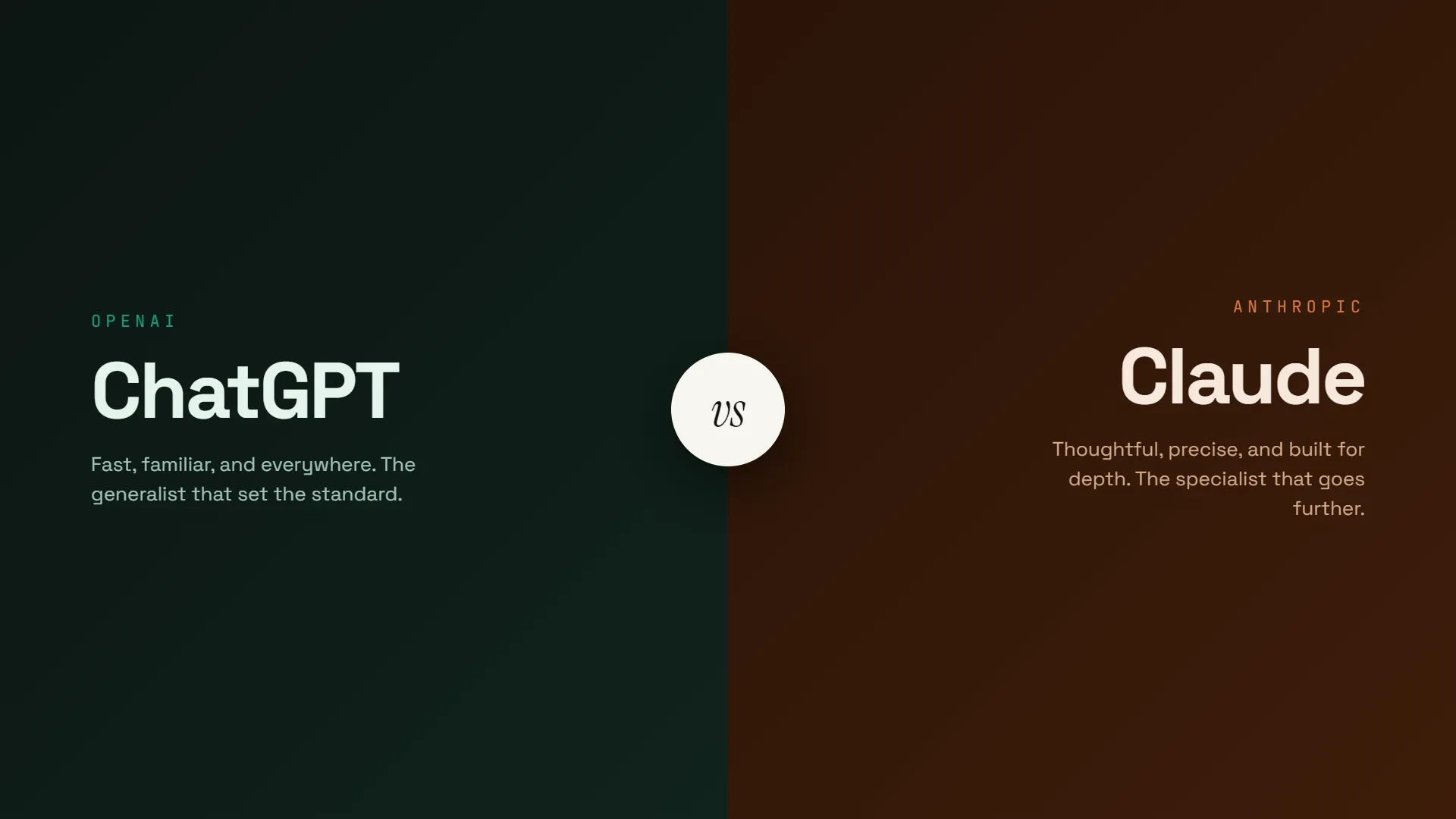
- Claude - Anthropic - Favoured for long documents, careful reasoning, natural writing
- Copilot - Microsoft - Woven into Word, Excel, PowerPoint, Teams and Outlook
- Perplexity - Perplexity AI - Answers with live, cited sources; research-first
- Grok - xAI - Real-time access to X (Twitter) for breaking trends
Every one of these is AI. Every one is a large-language-model chatbot. ChatGPT is simply the most famous house on a busy street — not the street itself. And chatbots are only one neighbourhood. Image generators, self-driving systems, medical-imaging tools, recommendation engines, translation apps, fraud detectors — all AI, none of them a chatbot at all. The category stretches far past the text box.
What ChatGPT Can & Can't?
Treating ChatGPT as "all of AI" also leads people to over-trust it. Knowing what it actually is helps you use it well. Here's the honest picture.
What it's good at:
- Drafting and editing text — emails, essays, summaries, outlines
- Explaining complicated ideas in plain language
- Writing and debugging code
- Brainstorming, translating, reformatting, and rephrasing
- Holding context across a back-and-forth conversation
Where it falls down:
- It can be confidently wrong. As OpenAI itself acknowledges, ChatGPT sometimes writes plausible-sounding but incorrect answers — a phenomenon usually called "hallucination." It predicts likely-sounding language; it does not verify truth.
- It doesn't understand the world the way you do. It's working from statistical patterns in text, not lived experience or genuine comprehension.
- It can go stale. A model's core knowledge is frozen at its training cut-off unless it's connected to live search.
- It isn't built for everything. For live citations you might reach for Perplexity; for deep work inside Excel, Copilot. Different jobs, different tools.
The practical takeaway: ChatGPT is a brilliant first-draft machine and a poor final authority. Use it to start thinking, then check anything that matters.
Why the Distinction is Worth Getting Right?
This isn't pedantry for its own sake. Muddling ChatGPT with AI quietly warps three things.
- Your expectations: If you think ChatGPT is AI, its mistakes feel like proof that "AI doesn't work." It isn't. It's one product with known limits, sitting beside quieter, extremely reliable AI you already trust every day without noticing.
- Your choices: People who only know ChatGPT default to it for everything. Understanding the wider field means reaching for the right tool — a research assistant, a spreadsheet helper, an image generator — instead of forcing one chatbot to do work it was never designed for.
- Your judgement about the future: Much of the public conversation about AI — jobs, safety, regulation — is really a conversation about the whole field, not one chatbot. Keeping the terms straight helps you follow the debate without mistaking a single product for the entire technology.
A Simple Mental Model to Keep
If you remember nothing else, keep this:
AI is the ocean. ChatGPT is one very famous fish.
The fish is real, impressive, and worth knowing. But it swims in vastly bigger water, alongside other fish, in a sea that existed long before it arrived and stretches far beyond where it swims.
Frequently Asked Questions
Is ChatGPT considered AI?
Yes. ChatGPT is a form of AI — specifically a generative AI chatbot built on a large language model. It's AI, but it isn't all of AI.
What's the difference between ChatGPT and AI?
AI is the broad field of machines that mimic human intelligence. ChatGPT is a single product, made by OpenAI, that uses one type of AI to have text conversations. AI is the category; ChatGPT is one item in it.
Is ChatGPT the same as GPT?
No. GPT is the underlying model — the engine. ChatGPT is the product built around it — the chat window, the app, the guardrails. OpenAI can upgrade the GPT engine while the ChatGPT product keeps its name.
Is ChatGPT the same as Google or Gemini?
No. Gemini is Google's own AI chatbot and a direct competitor to ChatGPT. Both are AI; they're separate products from separate companies.
Who owns ChatGPT?
ChatGPT is built and operated by OpenAI, an American AI company founded in 2015. Google, Anthropic, Microsoft and others build their own rival tools.
Is all AI a chatbot?
Not at all. Chatbots are one small slice of AI. Image generators, recommendation systems, fraud detection, self-driving technology and translation tools are all AI, and none of them is a chatbot.
The Bottom Line
ChatGPT is AI — but AI is enormously more than ChatGPT. One is a single, famous product with a launch date and a company behind it. The other is a decades-deep field that quietly runs a huge part of the modern world, most of it far out of sight.
Getting the difference straight isn't about winning an argument. It's about using these tools with clear eyes: knowing what ChatGPT is good for, where it fails, and how much bigger the landscape around it really is.
Your next step: open your AI tool of choice, ask it something you actually care about, and — this is the part that matters — check its answer against a source you trust. Treat it as a sharp assistant, not an oracle, and you'll get the best of what it offers without inheriting its blind spots.



Stay updated with our letter
Join our newsletter to receive the latest insights, tips, and stories directly to your inbox weekly.

We bring a unique perspective, offering readers insightful and thought-provoking content.



.avif)